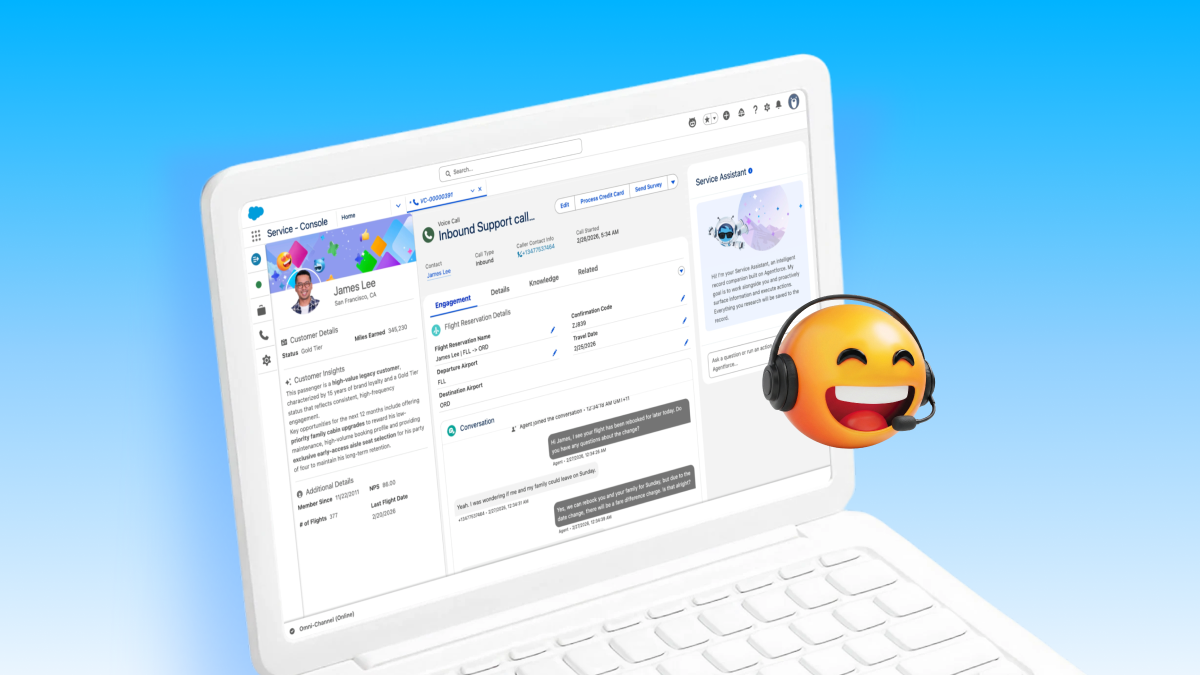
Customer calls in, navigates an IVR maze. Asks the chatbot, gets "let me connect you with an agent." The agent toggles between 5 windows searching for history. Data is piling up in the CRM, but at the actual customer touchpoint, it's not being used properly. Salesforce went head-on at this problem at Enterprise Connect 2026 — Agentforce Contact Center, a contact center that unifies voice, digital, AI agents, and CRM data into one native system.
What is this?
The contact center market has traditionally been CCaaS (Contact Center as a Service) vendors' territory. Players like Genesys, NICE, Five9, and Amazon Connect had the edge in voice infrastructure and routing, while Salesforce held the CRM data but left contact center execution to them. When Salesforce first launched Salesforce Contact Center in 2022, the focus was on "integration" with existing CCaaS vendors.
This time is different. Agentforce Contact Center isn't about integration — it's "native." Salesforce built its own telecommunications stack from scratch over 15 months. Voice runs directly inside the CRM. When a call comes in, real-time transcription happens, sentiment analysis runs, and the results are immediately recorded in the customer record. Not through a separate integration — all within a single system.
Zeus Kerravala (ZK Research) put it this way: "Salesforce is trying to eliminate the 'integration tax' that companies have accepted for years — the structure where customer data, workflows, AI, and voice all lived in separate systems that had to be stitched together."
The key is that the AI agent isn't just a chatbot. Salesforce calls this an "agentic contact center" — AI autonomously handles tasks like booking appointments, looking up documents, and checking order status, only passing complex issues to humans. When it hands off, the full conversation history and customer context transfer automatically, so customers don't have to repeat themselves.
And the technical backbone of this system is the hybrid agent. This part is especially important — let's dig deeper in the next section.
What changes?
The biggest difference is "where you place the AI." In the old structure, CRM (Salesforce) and contact center (Genesys/Five9, etc.) were connected via API, with AI layered on top as yet another separate system. Every time data moved between systems, there was latency and context was lost.
| Legacy (CRM + CCaaS integration) | Agentforce Contact Center | |
|---|---|---|
| Voice handling | Processed in external CCaaS → logs sent to CRM | CRM-native — real-time transcription + sentiment analysis + recording |
| AI agent | Separate AI bot → CRM query via API | Direct CRM data access, autonomous task execution |
| Handoff | Frequent context loss during system transitions | Full history auto-transferred on AI-to-human handoff |
| Admin view | Separate CCaaS dashboard + CRM dashboard | Single workspace for AI + human agents |
| Setup | Days to weeks for phone number and routing config | Phone numbers set up in minutes |
| Data utilization | Per-channel silos → manual integration needed | Real-time access to sales, marketing, and service data |
But "AI handles it on its own" is actually nerve-wracking in enterprise environments. What if the LLM gives customers a wrong answer? This is where Salesforce's Hybrid Reasoning architecture shines.
Hybrid agent = deterministic workflow + LLM reasoning
Salesforce calls this the "Agent Graph" — it breaks complex tasks into smaller sub-agents and manages their transitions with a finite state machine (FSM). The core idea is "sandwiching LLM conversational flexibility between guaranteed execution layers." For example, business-critical steps like identity verification or payment processing execute 100% deterministically (Apex, Flow, API), while understanding customer intent and responding in natural language is the LLM's job.
What provides more granular control is Agent Script. It has two syntaxes — -> (Logic Instruction) is a deterministic path that executes identically every time, and | (Prompt Instruction) is a natural language directive sent to the LLM. Developers can precisely control how much of the business logic is "must execute exactly like this" and where to open it up to "let AI decide."
Salesforce systematized this into Six Levels of Determinism — from autonomous selection → agent instructions → data grounding → agent variables → Apex/API/Flow actions → Agent Script, increasing the degree of determinism at each level. It's essentially providing a slider for "how much freedom to give AI."
Things to keep in mind
Currently, Agentforce Contact Center phone numbers are only available in the US and Canada. International expansion is planned for gradual rollout within 2026. Integration with existing 17 CCaaS vendor partners continues, so organizations that can't switch immediately can run hybrid operations.
The essentials: how to get started
- Check eligibility
Agentforce Contact Center is an add-on for Agentforce Service customers. If you're already on Service Cloud, the barrier to entry is low. Pricing hasn't been officially announced yet, so reaching out to Salesforce sales or a partner is the first step. - Review the Agentforce 100 program
Salesforce is running a program offering engineering support, executive-level resources, and commercial incentives to the first 100 organizations. You can take advantage of early adopter benefits. - Design hybrid agents
Analyze your existing contact center workflows and separate "must be deterministic" areas (authentication, payments, PII handling) from "can be delegated to LLM" areas (intent detection, FAQ responses, emotional support). The Six Levels of Determinism framework is a good starting point. - Leverage partners
Accenture (including NeuraFlash), Deloitte Digital, IBM Consulting, and PwC have already completed multi-day implementation workshops. Working with them rather than building in-house reduces initial risk. - Gradual rollout
Travel and hospitality are seeing 40–60% AI self-resolution rates. However, results vary significantly by industry and call complexity, so start with a pilot, measure containment rates, and scale from there.