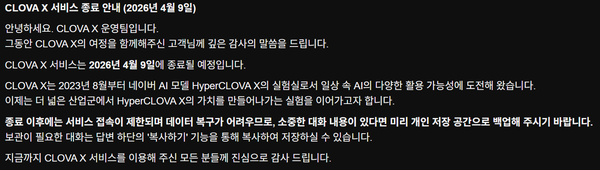
On April 9, 2026, Naver shut down CLOVA X. From its August 2023 launch — 2 years and 8 months. It started with the tagline "the AI that understands Korean best," but the ending was quiet. Naver called it "wrapping up an experiment," but the numbers tell a harsher story — ChatGPT had 21.25 million MAU in Korea while CLOVA X didn't even crack the top 10 apps.
What happened?
To understand CLOVA X's shutdown, you need to see the Korean AI chatbot timeline first.
| Date | Event | Significance |
|---|---|---|
| Nov 2022 | ChatGPT launches | Global generative AI race begins |
| Aug 2023 | Naver CLOVA X launches | Positioned as "Korean-specialized AI" |
| Sep 2023 | Naver Cue: launches | Generative AI search service (closed beta) |
| May 2024 | GPT-4o launches | Massive Korean language improvement — neutralizes CLOVA X's "Korean advantage" |
| Apr 2025 | Ghibli-style images go viral in Korea | ChatGPT Korean user base explodes |
| Oct 2025 | ChatGPT Korea MAU hits 21.25M | Korea becomes world's #2 ChatGPT subscription market |
| Nov 2025 | Triple Skill service shuts down | CLOVA ecosystem contraction begins |
| Jan 2026 | Skill service shuts down | CLOVA add-on features closing in sequence |
| Apr 9, 2026 | CLOVA X and Cue: shut down | Standalone AI chatbot experiment ends |
The turning point was May 2024. When GPT-4o dropped, its Korean language abilities improved dramatically. Before that, "ChatGPT is great in English but awkward in Korean" was CLOVA X's entire reason to exist — and that card vanished. Korea's AI usage grew 80%+ from October 2024 onward, and ChatGPT captured most of that growth.
Eventually Naver had to admit it. Their official statement — "we'll create HyperCLOVA X value across broader industries" — translates to: we can't beat ChatGPT as a standalone chatbot.
What went wrong?
A side-by-side comparison of CLOVA X and ChatGPT shows why Korea's AI chatbot struggled.
| Category | CLOVA X | ChatGPT |
|---|---|---|
| Korea MAU (Oct 2025) | Outside top 10 (web-only, no mobile app) | 21.25 million |
| Korean ability | Early advantage → gap eliminated post-GPT-4o | Reached practical Korean fluency with GPT-4o |
| Multilingual support | Korean & English focused | 100+ languages |
| Service status | "Experimental service" for 2 years 8 months | Full production, paid subscription model established |
| Ecosystem | Limited integration with Naver services | GPTs, plugins, API ecosystem |
| Investment scale | Undisclosed (portion of Naver R&D budget) | OpenAI raised $11B+ cumulative |
| Model updates | HyperCLOVA X irregular updates | GPT-4 → 4o → o1 → o3 rapid generations |
Looking at this, you might say "it's just a capital gap — nothing they could do." Partly true. OpenAI raised $11B+, and Naver can't match that scale. But the real problems went beyond funding.
Three things CLOVA X got wrong
First, it never graduated from 'experimental service' in 2 years and 8 months. Without transitioning to a full product, there was no paid model, and users saw it as "a service that could disappear any day."
Second, it never found a killer use case. ChatGPT kept adding practical features — code writing, image generation, data analysis — while CLOVA X stayed in general conversation territory.
Third, integration with Naver's own services was weak. Without deep connections to Naver Search, Shopping, and Maps, even Naver ecosystem users had no compelling reason to use CLOVA X.
Kakao reached a similar conclusion. Kakao's AI search service was also scaled back, and instead "ChatGPT for Kakao" — ChatGPT integrated into KakaoTalk — secured 8 million users. Rather than competing with their own model, they pivoted to embedding AI into their platform where users already were.
Lessons for surviving in AI
CLOVA X's shutdown doesn't mean "Korean AI is dead." It actually shows what conditions local AI services need to survive. Naver is already finding its next direction, and other players are already moving.
- Embed AI into existing services, don't build standalone chatbots
This is exactly where Naver is heading. AI Briefing already covers 20% of Naver search queries, and the 'AI Tab' launching in H1 2026 is a conversational interface connecting search to purchase. KakaoTalk's ChatGPT integration (8M users) follows the same playbook. The lesson: don't ask "let's build our own ChatGPT." Ask "how do we embed AI into our services?" - Target areas where global models are weak
Experts are clear about where Korean AI should focus — Korean legal and medical document processing, domestic-specialized financial AI, deep integration with local commerce platforms. Even though ChatGPT improved at Korean, there are still big gaps in domain knowledge like Korean tax law, medical regulations, and real estate rules. - Win in B2B
Naver Cloud's CLOVA Studio and HyperCLOVA X API are still going strong. Providing customized AI combined with enterprise clients' proprietary data is a completely different game from the "ChatGPT vs CLOVA X" consumer battle. Naver reduced parameters by 40% while boosting performance, cutting operating costs by 50%+. - Run it as a 'business,' not an 'experiment'
CLOVA X's biggest mistake was staying an "experimental service" for 2 years and 8 months. Without a paid model, clear target users, and differentiated features, "let's launch and see" just produces "let's not use it and see" from users. - Pivot to AI agents
Naver's next play is AI agents. Shopping agent (Naver Plus Store, launched late March 2026) and AI Tab (search-to-purchase flow, mid-2026) lead the way. Not just "AI you chat with" but "AI that books, buys, and searches for you" — a completely different form factor. SK Telecom's A.dot (188K MAU) is going the same direction as a telecom-specialized agent.
The takeaway for business leaders
What CLOVA X's shutdown tells us is clear — AI competitiveness lives in distribution and use cases, not in the model itself. If you can't build your own LLM (most companies can't), it's far more practical to take ChatGPT's API or Claude's API and embed it deep into your own service. "Building AI" and "building a business with AI" are entirely different games.