AI will do all the coding, so we won't need developers anymore, right? Here's the thing — Citadel Securities analyzed Indeed data and found that software engineer job postings are surging 11% year over year. In a market where overall postings are flat.
What Is It?
Wall Street market maker Citadel Securities published a fascinating chart in their February 2026 report, The 2026 Global Intelligence Crisis. They analyzed daily job posting data from Indeed, and here's what stands out:
While the "AI is taking jobs" narrative dominates the conversation, the data points in the exact opposite direction. Citadel Securities put it plainly:
"In spite of the current displacement narrative — job postings for software engineers are rising rapidly."1
And it's not just Citadel saying this. The U.S. Bureau of Labor Statistics projects software developer employment to grow 15–17.9% over the next decade. Since ChatGPT launched, we actually need more developers, not fewer.
Why is this happening? This is where the Jevons Paradox comes in.
In 1865, British economist William Stanley Jevons noticed something counterintuitive: as steam engines got more efficient, coal consumption should have dropped. Instead, it exploded. Greater efficiency widened coal's applications, and total demand grew far beyond what anyone expected.
The same thing is happening with software. AI has dramatically lowered the cost of writing code, and suddenly software that was never worth building before is getting built.
What Changes?
Let's compare the "AI replaces developers" view against the "AI expands developer demand" view, using actual data.
| Substitution Theory | Expansion Theory | |
|---|---|---|
| Core logic | AI codes, so coders are unnecessary | Coding cost ↓ → things to build ↑ → hiring ↑ |
| Hiring data | Expected to decline | Actually: 11% YoY increase (Citadel/Indeed)1 |
| BLS outlook | Long-term decline | Software developers: 15% growth (2024–2034)2 |
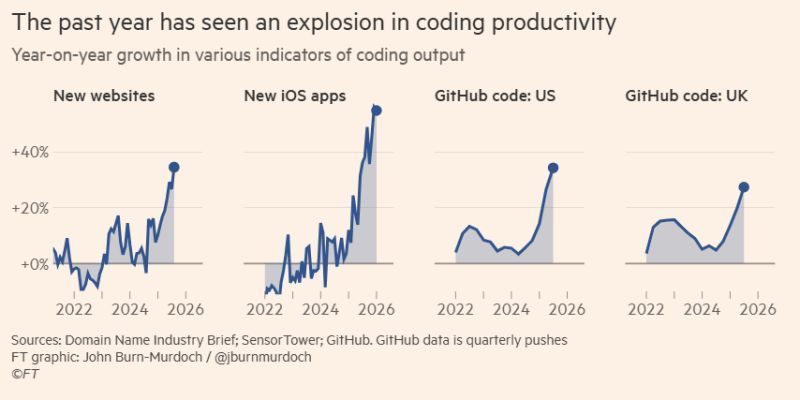
| Code output | Only efficiency per headcount rises | GitHub pushes +35%, new iOS apps +50%4 |
| Historical precedent | This time is different | Spreadsheets → more accountants, PCs → more office jobs1 |
| AI adoption speed | Rapid displacement imminent | Daily AI use at work is stable, not accelerating1 |
The key distinction here is programmer vs. software developer. Here's what BLS data shows:
"Computer programmers" (the narrow role of translating specs into code) — employment down 27.5% since 2023. Lowest since 1980.
"Software developers" (system design, requirements analysis, architecture decisions) — employment down just 0.3%. BLS projects 17.9% growth over the next decade.
In other words, AI eliminated the "typing code" role and expanded the "deciding what to build and designing systems" role. The narrow job is shrinking; the broad one is growing.
Jim Rutt explains the crucial difference between software and coal. Software is combinatorial:
"A company builds a customer database; now it needs analytics, reporting, API access, mobile views, compliance logging, backup systems, and migration tools. Each layer creates demand for the next. Coal never did this."3
Getting Started
As BLS data clearly shows, AI threatens the "spec-to-code translation" role. Architecture design, failure analysis, security reasoning, domain modeling, cross-team communication — if you're positioned here, AI isn't a threat. It's a lever.
Market fear has temporarily eased the competition for developer talent. But as Citadel's data shows, actual demand is rebounding fast. "AI will replace them, so we don't need to hire" is a bet you'll likely regret in six months.
Think about a 50-person manufacturer. They have one ERP they hate, a handful of spreadsheets, and a whiteboard for production scheduling. When AI drops development costs by 10x, CNC output analysis, operator-level defect tracking, automated quality drift detection, industry-specific compliance documentation — all of it suddenly becomes worth building. Every hospital, law firm, school district, and logistics company has software like this waiting to exist.
Let's be honest — traditional entry-level coding paths are narrowing. But the value of "AI + domain expertise" is exploding. Developers who deeply understand a specific industry (healthcare, manufacturing, logistics) while wielding AI tools will be in demand far beyond the BLS 15% projection.
Deep Dive Resources
- The 2026 Global Intelligence Crisis — Citadel Securities: The original report. Macro-level analysis of employment, inflation, and demand dynamics in the AI era.
- Jevons' Paradox and the Fate of Software Developers — Jim Rutt: A deep analysis of why the Jevons Paradox applies even more strongly to software than it did to coal.
- The Jevons Paradox of AI — Myoung Cha: How data from programmers and medical scribes reveals the job restructuring pattern in the AI era.
- Software Developers Outlook — BLS: Official U.S. Bureau of Labor Statistics employment projections for software developers.
- Tech Hiring Rebound — Benzinga/Yahoo Finance: Analysis of the tech hiring rebound based on Citadel Securities data.
Sources
- The 2026 Global Intelligence Crisis — Citadel Securities (Feb 2026)
- Software Developers, QA Analysts, and Testers — U.S. Bureau of Labor Statistics
- Jevons' Paradox and the Fate of Software Developers — Jim Rutt (Mar 2026)
- The Jevons Paradox of AI — Myoung Cha (Feb 2026)
- New Data Shows A Surprising Rebound In Tech Hiring — Benzinga (Mar 2026)
- Jobs Mentioning AI Are Growing Amid Broader Hiring Weakness — Indeed Hiring Lab (Jan 2026)